


An enthusiast named Sean Ryan built a solar- powered electric bike and rode it to the Alps as part of the international Sun Trip competition. During the trip, he covered over 1,000 km in France, including several challenging mountain passes. However, he was forced to use the regular power grid twice.
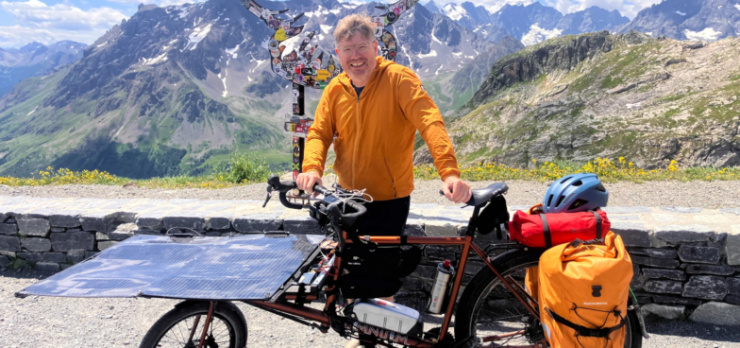
The design is based on the Omnium cargo bike from Paradise Cycles. Ryan installed solar panels on its front platform ; if they are removed, the bike can be used as a regular bike. A 250-watt Tongsheng TSDZ2B central motor provides propulsion, while energy storage is provided by two 36-volt batteries from EM3-EV and Infinit.
The solar panels are connected via a Genasun GVB-8 boost MPPT controller, which converts unstable voltage into voltage suitable for charging the battery. Ryan initially planned to use three 100-watt panels, but during testing, it became clear that this design was too long and cumbersome for urban use. Ultimately, the solar system's output had to be reduced to 200 watts.
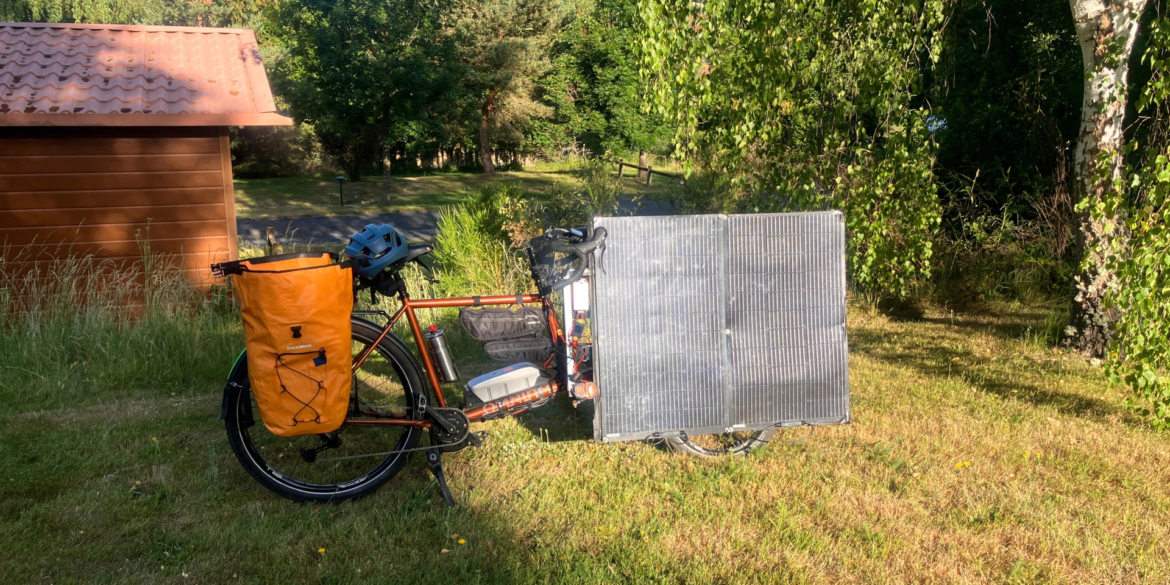
The fully loaded bike, including touring and photography gear, weighed 61 kg. During testing in the UK, it consumed approximately 6.2–7.5 Wh per kilometer, while the panels produced between 70 and 100 W, depending on the weather and sun position.
On the most challenging stage, Ryan rode 130 km over rough terrain. During that day, the controller recorded 985 Wh of solar energy entering the bike's electric system. The average speed was 21–22 km/h.
The Sun Trip's Alpine stage took place along the Auvergne-Rhône-Alpes route. Participants had to overcome, among other things, the Galibier Pass (2,642 m) and the Iséran Pass (approximately 2,770 m), the highest paved pass in the Alps. The main rule of the competition is simple: using grid electricity disqualifies the participant from the solar bike competition.
The problems began during a heat wave. Temperatures in France reached 41°C, and forest fires raged near Lyon . One of the Infinit batteries overheated, causing its battery management system (BMS) to stop accepting solar power.
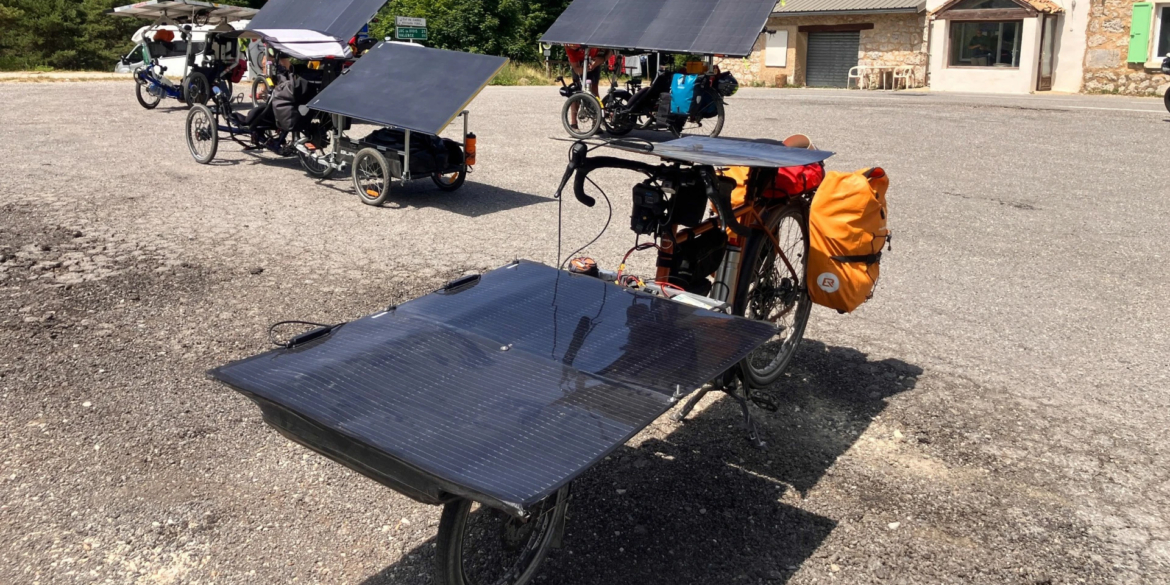
Sean believes the battery should have been placed in a completely shaded area. He also doesn't rule out the possibility that the additional heat could have been caused by the Infinit's design: its elements are mechanically secured, not spot-welded like in conventional battery packs. However, Ryan emphasized that he can't definitively pinpoint this as the cause of the problem.
Due to his low energy reserves, Ryan had to connect to the grid twice. He only received about 1 kWh this way, after which he was no longer eligible for the solar ranking.
The electric motor proved a particular problem. On particularly long climbs, the 250-watt Tongsheng overheated. To continue moving, Ryan had to stop and wait for the motor to cool, and on several occasions he even sprayed water on its body.
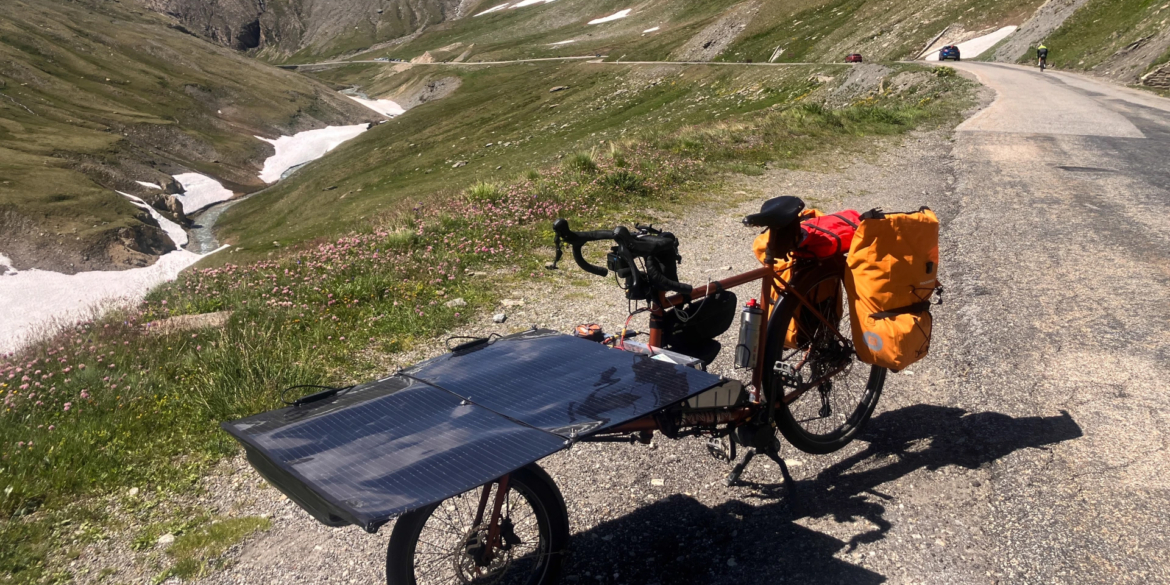
The motor worked best at high RPMs and low gears. On steep climbs, Ryan engaged the lowest gear and pedaled slowly, allowing the motor to operate in its more efficient range. He reported that the motor performed perfectly for its rated output of 250 watts.
Ryan is now planning a significantly more challenging challenge: participating in the Sun Trip from France to China in 2028. The preliminary route, approximately 15,000 km long, is planned to pass through the Balkans, Turkey, the Caucasus, Central Asia, and western China, skirting Russia and crossing the Caspian Sea. Around 40 participants are expected, but the route and rules are subject to change.
A distance like this would require a significantly larger solar panel area. However, Ryan has no plans to simply expand the current design. He believes that on a multi-day route, aerodynamics and comfort are key, not just panel area.
Therefore, the next bike may feature a semi-recumbent design with an extended wheelbase. Ryan plans to position the bike closer to the front of the current cargo bed, with a wider sunshade mounted on top. This design should simultaneously increase panel area, improve aerodynamics, and make the riding position more comfortable for long rides.
Ryan considers his first project a success precisely because of its simplicity. He says a simple cargo bike, a 250-watt central motor, a single solar controller, and 200-watt panels were enough to prove the concept's viability. He's now using this experience to build a much more complex bike.
The design is based on the Omnium cargo bike from Paradise Cycles. Ryan installed solar panels on its front platform ; if they are removed, the bike can be used as a regular bike. A 250-watt Tongsheng TSDZ2B central motor provides propulsion, while energy storage is provided by two 36-volt batteries from EM3-EV and Infinit.
The solar panels are connected via a Genasun GVB-8 boost MPPT controller, which converts unstable voltage into voltage suitable for charging the battery. Ryan initially planned to use three 100-watt panels, but during testing, it became clear that this design was too long and cumbersome for urban use. Ultimately, the solar system's output had to be reduced to 200 watts.
The fully loaded bike, including touring and photography gear, weighed 61 kg. During testing in the UK, it consumed approximately 6.2–7.5 Wh per kilometer, while the panels produced between 70 and 100 W, depending on the weather and sun position.
On the most challenging stage, Ryan rode 130 km over rough terrain. During that day, the controller recorded 985 Wh of solar energy entering the bike's electric system. The average speed was 21–22 km/h.
The Sun Trip's Alpine stage took place along the Auvergne-Rhône-Alpes route. Participants had to overcome, among other things, the Galibier Pass (2,642 m) and the Iséran Pass (approximately 2,770 m), the highest paved pass in the Alps. The main rule of the competition is simple: using grid electricity disqualifies the participant from the solar bike competition.
The problems began during a heat wave. Temperatures in France reached 41°C, and forest fires raged near Lyon . One of the Infinit batteries overheated, causing its battery management system (BMS) to stop accepting solar power.
Sean believes the battery should have been placed in a completely shaded area. He also doesn't rule out the possibility that the additional heat could have been caused by the Infinit's design: its elements are mechanically secured, not spot-welded like in conventional battery packs. However, Ryan emphasized that he can't definitively pinpoint this as the cause of the problem.
Due to his low energy reserves, Ryan had to connect to the grid twice. He only received about 1 kWh this way, after which he was no longer eligible for the solar ranking.
The electric motor proved a particular problem. On particularly long climbs, the 250-watt Tongsheng overheated. To continue moving, Ryan had to stop and wait for the motor to cool, and on several occasions he even sprayed water on its body.
The motor worked best at high RPMs and low gears. On steep climbs, Ryan engaged the lowest gear and pedaled slowly, allowing the motor to operate in its more efficient range. He reported that the motor performed perfectly for its rated output of 250 watts.
Ryan is now planning a significantly more challenging challenge: participating in the Sun Trip from France to China in 2028. The preliminary route, approximately 15,000 km long, is planned to pass through the Balkans, Turkey, the Caucasus, Central Asia, and western China, skirting Russia and crossing the Caspian Sea. Around 40 participants are expected, but the route and rules are subject to change.
A distance like this would require a significantly larger solar panel area. However, Ryan has no plans to simply expand the current design. He believes that on a multi-day route, aerodynamics and comfort are key, not just panel area.
Therefore, the next bike may feature a semi-recumbent design with an extended wheelbase. Ryan plans to position the bike closer to the front of the current cargo bed, with a wider sunshade mounted on top. This design should simultaneously increase panel area, improve aerodynamics, and make the riding position more comfortable for long rides.
Ryan considers his first project a success precisely because of its simplicity. He says a simple cargo bike, a 250-watt central motor, a single solar controller, and 200-watt panels were enough to prove the concept's viability. He's now using this experience to build a much more complex bike.