


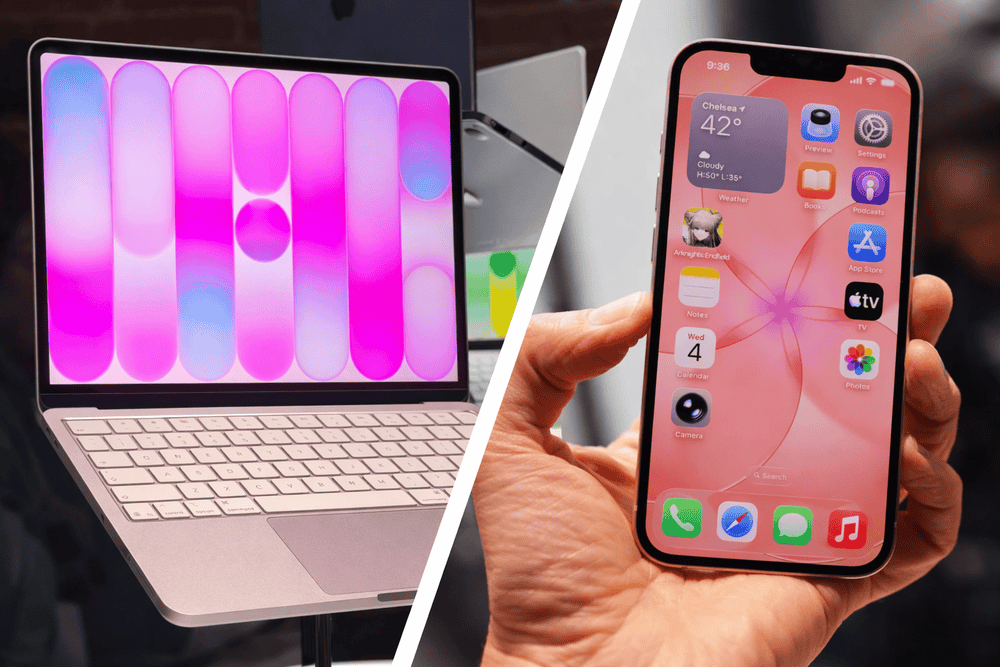


Apple still runs on the iPhone. That’s not exactly news, and it’s still true in 2026. But what did catch my attention is how differently Apple seems to treat buyers shopping at the same $599 price point.
The new MacBook Neo, starting at $599, comes across like Apple actually wanted to make an affordable Mac people would feel good about buying. It has an all-aluminum design, a 13-inch Liquid Retina display, and the usual Apple Silicon pitch around long battery life and Apple Intelligence. On paper, that already sounds more polished than I expected for the price.
The iPhone 17e, also starting at $599, lands differently for me. Yes, it gets the A19 chip, MagSafe, and 256GB of base storage, which are real upgrades and absolutely plausible for 2026. But it still reads like Apple built it by asking, “What’s the minimum we can include before people complain too loudly?” rather than “How do we make this feel like a steal?”
I found that contrast way more interesting than the specs themselves. When two Apple products share the same starting price, you’d expect the compromises to feel equally fair. They don’t.
MacBook Neo feels like Apple actually tried
What I like about the MacBook Neo is that it doesn’t sound cheap in the bad way. Apple’s official specs point to a 13-inch Liquid Retina display, 500 nits of brightness, 3.6 million pixels, and a full aluminum chassis, which is a pretty strong package for a laptop that starts at $599.
That matters because budget laptops are usually where companies start cutting corners you can immediately feel: flimsy plastic, bad screens, weak keyboards, mediocre thermals, and the kind of trackpad that makes you want to plug in a mouse out of self-defense. The MacBook Neo, at least from its positioning and the early coverage around it, seems designed to avoid that trap. The Verge even highlighted its repairability and the unusual availability of replacement parts, which gives it an even less “throwaway budget product” vibe.
In my testing on a current laptop lineup, that’s usually the first thing I notice with cheaper machines: not benchmark numbers, but whether the device feels compromised the second I open the lid. The MacBook Neo doesn’t appear to send that signal. My instinct is that Apple wanted first-time Mac buyers to feel slightly spoiled here, not merely accommodated.
iPhone 17e is better than old “cheap iPhones,” but it still feels constrained
To be fair, the iPhone 17e isn’t badly specced. Apple gives it a 6.1-inch Super Retina XDR display, A19, MagSafe, USB-C, and 256GB base storage. That is a much healthier starting configuration than older budget iPhones used to offer.
But then the fine print kicks in. Apple’s own comparison page notes the absence of ProMotion, Always-On display, and Dynamic Island, and the product is still positioned as the “good enough” iPhone rather than the exciting one. The camera story is better than your draft suggested, by the way: it’s not just “one basic rear camera” in a dismissive sense. Apple is pitching a 48MP Fusion camera, so the more accurate criticism is not that it’s useless, but that the overall package still feels tightly controlled.
I tried comparing this value equation the way a normal buyer would, not the way a spec-sheet warrior would. If I hand someone a $599 laptop made of aluminum with a sharp 13-inch display, it feels generous. If I hand them a $599 phone and immediately have to explain what’s missing from the display and why it only exists as the “e” model, that’s a different emotional pitch.
The weird part is that both products cost the same
This is where Apple’s strategy gets fascinating. The company seems comfortable making the MacBook Neo feel like a breakthrough product for budget buyers, while the iPhone 17e feels more like a carefully managed fallback option. Same headline price, very different energy.
That may be because Apple can afford to be more aggressive with the Mac right now. Reports this month suggest the MacBook Neo is selling extremely well, with demand strong enough to push delivery windows out. Meanwhile, the iPhone remains the center of Apple’s business, which may be exactly why the company is more cautious there. When your biggest revenue engine is the iPhone, you don’t rush to make the cheapest model too appealing.
Honestly, that’s what this comes down to for me. The MacBook Neo feels like Apple trying to win new users. The iPhone 17e feels like Apple protecting the ladder above it.
My take
If I were recommending between the two from a pure value perspective, I’d say the MacBook Neo is the more interesting Apple product right now. It looks like the kind of device that could make people say, “Wait, Apple made this for $599?” And that’s a powerful reaction.
The iPhone 17e isn’t a bad phone. The numbers are plausible, the upgrades are real, and $599 for 256GB is objectively better than the old nickel-and-dime Apple approach. But emotionally, it still feels like a compromise-first product.
My recommendation is simple: if you’re judging Apple on which of these two products feels more generous, more confident, and more fun, the MacBook Neo wins without much effort. The iPhone 17e makes sense. The MacBook Neo actually makes a point.