
The remnants of glaciers on Mars suggest that some forms of water may still exist on the planet .
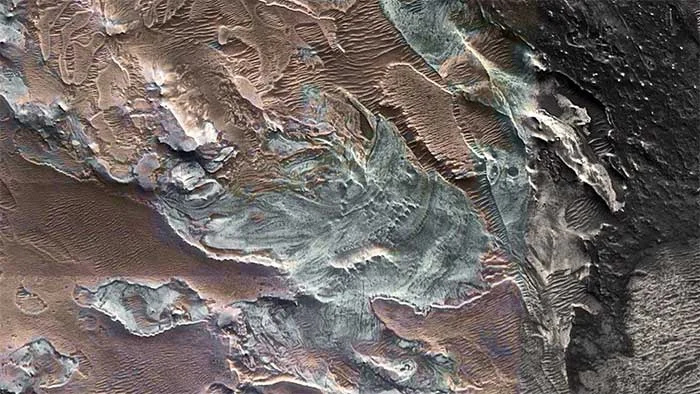
Scientists have discovered remarkable traces of mineral deposits near the planet's equator. The deposits there often contain light-colored sulfate salts .
Upon closer examination, the scientists recognized characteristics of the glacier, including streaks called glacial deposits —pieces of material deposited or displaced by the glacier's movement. The research team also discovered cracks, or deep, wedge-shaped cavities—things that often form inside glaciers.
The discovery was announced on March 15 at the 54th Annual Planetary and Lunar Science Conference in Woodlands, Texas, according to CNN.
"What we found wasn't ice, but a salt deposit with detailed morphological features of a glacier," said Dr. Pascal Lee, senior planetary scientist at the SETI Institute and the Mars Institute.
Researchers believe the glacier is 6km long and about 4km wide, with a height of 1.3 to 1.7km. The glacier is thought to have existed during the Amazonian period, a geological period on Mars that began 2.9 billion years ago and is still ongoing.
Researchers don't know if any ice remains beneath the sediment, and they plan to investigate that, and if so, whether any other ice formations exist nearby.
Scientists have discovered remarkable traces of mineral deposits near the planet's equator. The deposits there often contain light-colored sulfate salts .
Upon closer examination, the scientists recognized characteristics of the glacier, including streaks called glacial deposits —pieces of material deposited or displaced by the glacier's movement. The research team also discovered cracks, or deep, wedge-shaped cavities—things that often form inside glaciers.
The discovery was announced on March 15 at the 54th Annual Planetary and Lunar Science Conference in Woodlands, Texas, according to CNN.
"What we found wasn't ice, but a salt deposit with detailed morphological features of a glacier," said Dr. Pascal Lee, senior planetary scientist at the SETI Institute and the Mars Institute.
Researchers believe the glacier is 6km long and about 4km wide, with a height of 1.3 to 1.7km. The glacier is thought to have existed during the Amazonian period, a geological period on Mars that began 2.9 billion years ago and is still ongoing.
Researchers don't know if any ice remains beneath the sediment, and they plan to investigate that, and if so, whether any other ice formations exist nearby.


