


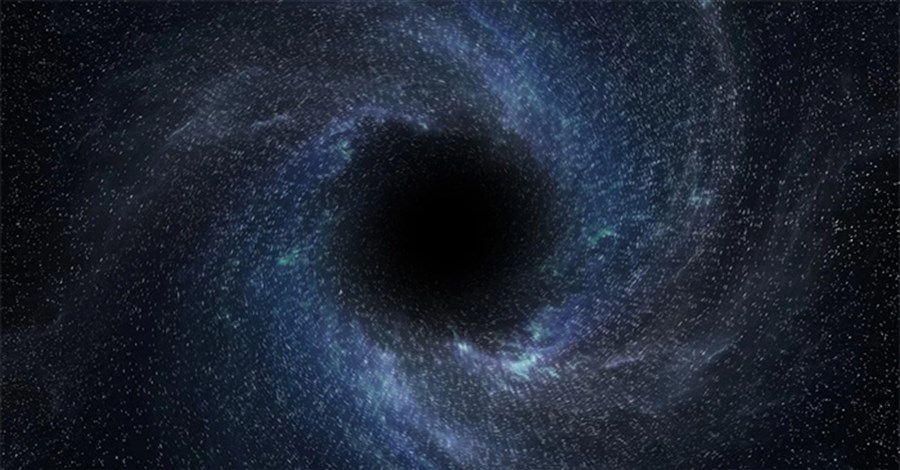
A team of astrophysicists from the Institute for Advanced Study and the Flatiron Institute has built the most detailed computer model yet of how matter falls into a black hole. Their work marks a major leap forward in black hole physics—not because it offers a prettier animation, but because it captures the underlying physics with a level of realism that had long been out of reach.
Published in The Astrophysical Journal, the study is the first to simulate luminous black hole accretion in full general relativity under radiation-dominated conditions without relying on the kinds of simplifying assumptions researchers had to use in the past.
Lead author Lizhong Zhang said this is the first time scientists have been able to see, with real accuracy, what happens when the most important physical processes in black hole accretion are all included at once. That matters because these systems are brutally nonlinear: even one seemingly modest approximation can completely change the outcome.

The result is striking. The simulations reproduce behavior that astronomers actually observe in the universe, from ultraluminous X-ray sources to X-ray binaries. In a sense, the researchers are not just studying black holes with telescopes anymore. They are “observing” them with supercomputers.
Simulating how matter really falls into a black hole
In the new study, the team explored accretion flows in radiation-dominated environments under a wide range of conditions. They varied the rate at which matter falls into the black hole, tested two different black hole spins, and ran models with different magnetic field configurations.
What made this possible was a new algorithm that directly solves the radiation transport equation in full general relativity—something that was previously close to impossible because the computational cost was simply too high. That barrier has now been broken by modern exascale supercomputers.
The simulations show that when a black hole feeds at rates above the so-called Eddington limit, the inflowing matter forms thick disks supported by radiation pressure and drives powerful outflows along the equatorial plane. Near the center, a narrow funnel-like photosphere appears, making it difficult for light to escape. The result is very low radiative efficiency: much of the energy gets trapped instead of being released as radiation.
The Eddington limit is the theoretical brightness threshold at which outward radiation pressure becomes strong enough to push infalling matter away, effectively limiting how fast a black hole or star can keep growing.
Why magnetic fields matter so much
At accretion rates near or below the Eddington limit, the system behaves differently. Here, the structure of the flow depends strongly on magnetic flux.
If there is net vertical magnetic flux threading the disk, the accreting material forms a thin, dense layer in the midplane surrounded by a magnetically dominated corona. Without that vertical flux, the entire disk remains magnetically dominated.
The models in this study did not reach the so-called magnetically arrested disk, or MAD, regime—an extreme state in which magnetic fields become strong enough to choke off the inward flow of matter. Even so, in cases with net magnetic flux and rapidly spinning black holes, the simulations still produced extremely powerful relativistic jets.
Why stellar-mass black holes are so important
The study focused mainly on stellar-mass black holes, which are roughly ten times the mass of the Sun. These objects are much harder to observe directly than the supermassive black holes at the centers of galaxies, which can now be imaged under special conditions. Stellar-mass black holes usually appear only as points of light, so scientists often have to infer their structure and behavior from the radiation spectrum they emit.
One advantage, however, is speed. Stellar-mass black holes can change dramatically over timescales of minutes to hours, allowing astronomers to watch their behavior evolve in something close to real time.
The new simulations align well with real observations, including radiation spectra from X-ray binaries and ultraluminous X-ray sources such as Cyg X-3 and SS433. The team also suggests that their super-Eddington models could help explain the mysterious “little red dots” recently spotted by the James Webb Space Telescope.
Powered by two of the most advanced supercomputers on Earth
This work depended on two of the fastest supercomputers in the world: Frontier, an AMD-powered exascale machine at Oak Ridge National Laboratory, and Aurora, an Intel-based exascale system at Argonne National Laboratory.
These systems can perform calculations at exascale—roughly a quintillion operations per second—giving scientists the raw power needed to solve physical equations that were previously too complex to handle in a realistic way.
Christopher White designed the radiation transport algorithm, while Patrick Mullen implemented it in AthenaK, a simulation framework optimized for exascale computing. AthenaK itself has been developed as a high-performance astrophysics code built to run efficiently on modern architectures.
What comes next
The team now wants to extend the same methods to supermassive black holes, the cosmic monsters that play a central role in shaping galaxies. They also plan to refine the models further so they can capture the interaction between radiation and matter under an even broader range of conditions.
Co-author James Stone said the project stands out for two reasons. First, it took years of work to develop the mathematical methods and software needed to simulate systems this complex. Second, it required access to an extraordinary amount of computing time on the largest supercomputers in the world. The next challenge, he suggested, is not merely running the simulations—but fully understanding the scientific insight they are starting to reveal.
In other words, this is no longer just a story about faster machines.
It is a story about finally being able to ask black holes harder questions—and getting answers detailed enough to change how we understand some of the most extreme objects in the universe.









'%3e%3cg id='Final-Copy-2_2_' transform='translate(1275.000000, 200.000000)'%3e%3cpath class='st0' d='M7.4,12.8h6.8l3.1-11.6H7.4C4.2,1.2,1.6,3.8,1.6,7S4.2,12.8,7.4,12.8z'/%3e%3c/g%3e%3c/g%3e%3c/g%3e%3cg id='final---dec.11-2020'%3e%3cg id='_x30_208-our-toggle' transform='translate(-1275.000000, -200.000000)'%3e%3cg id='Final-Copy-2' transform='translate(1275.000000, 200.000000)'%3e%3cpath class='st1' d='M22.6,0H7.4c-3.9,0-7,3.1-7,7s3.1,7,7,7h15.2c3.9,0,7-3.1,7-7S26.4,0,22.6,0z M1.6,7c0-3.2,2.6-5.8,5.8-5.8 h9.9l-3.1,11.6H7.4C4.2,12.8,1.6,10.2,1.6,7z'/%3e%3cpath id='x' class='st2' d='M24.6,4c0.2,0.2,0.2,0.6,0,0.8l0,0L22.5,7l2.2,2.2c0.2,0.2,0.2,0.6,0,0.8c-0.2,0.2-0.6,0.2-0.8,0 l0,0l-2.2-2.2L19.5,10c-0.2,0.2-0.6,0.2-0.8,0c-0.2-0.2-0.2-0.6,0-0.8l0,0L20.8,7l-2.2-2.2c-0.2-0.2-0.2-0.6,0-0.8 c0.2-0.2,0.6-0.2,0.8,0l0,0l2.2,2.2L23.8,4C24,3.8,24.4,3.8,24.6,4z'/%3e%3cpath id='y' class='st3' d='M12.7,4.1c0.2,0.2,0.3,0.6,0.1,0.8l0,0L8.6,9.8C8.5,9.9,8.4,10,8.3,10c-0.2,0.1-0.5,0.1-0.7-0.1l0,0 L5.4,7.7c-0.2-0.2-0.2-0.6,0-0.8c0.2-0.2,0.6-0.2,0.8,0l0,0L8,8.6l3.8-4.5C12,3.9,12.4,3.9,12.7,4.1z'/%3e%3c/g%3e%3c/g%3e%3c/g%3e%3c/g%3e%3c/svg%3e)


0 comments