



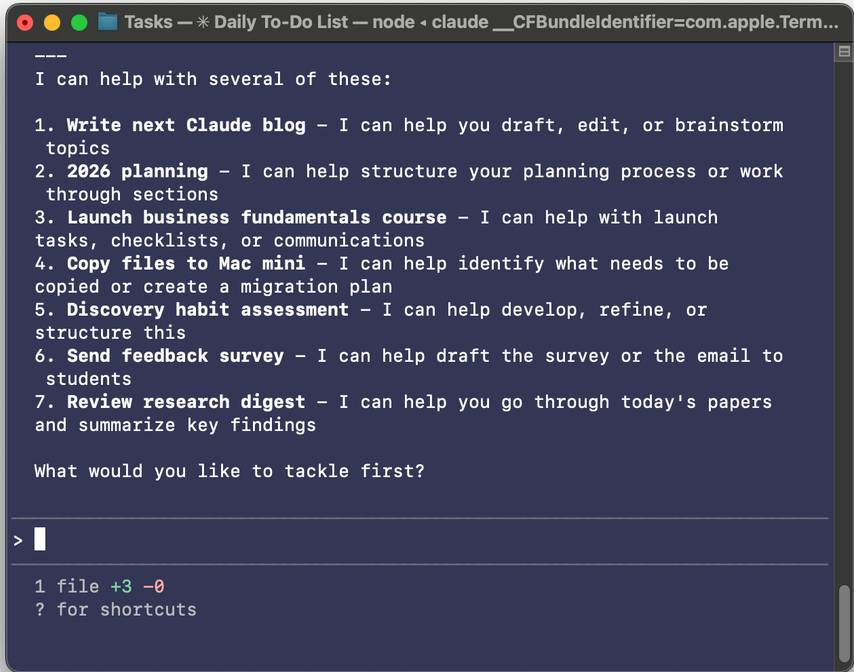
For some people, the morning starts the same way every day: they sit down at their computer with a cup of coffee, type /today into Claude Code, and take those first few sips while Claude gets to work.
It pulls in new tasks from Trello, creates a today.md file with the day’s to-do list, and even builds a short research brief based on the latest academic papers related to topics they care about.
After reviewing that file, they map out the rest of the day. And more and more often, they find themselves asking Claude a simple question:

“Is there anything on my to-do list that you can take care of for me?”
That raises a bigger question: What should you actually automate with AI?
Understanding what AI workflows can really do for you
A lot of people began their AI journey the same way: using ChatGPT in a browser shortly after it launched. At first, the use cases were simple. Then, after a few months, the questions started getting more ambitious.
Can AI help with this too?
As people explored more possibilities—and got tired of endless copying and pasting—they moved on to tools like Claude Code. But the mindset stayed the same: keep testing the limits of what large language models can actually do in real work.
The default instinct is often to try everything with AI.
But there are only so many hours in a day. At some point, you have to decide which tasks are worth turning into repeatable workflows, which ones are worth handling case by case, and which ones are still better left entirely to you.
A workflow is simply a sequence of steps required to complete a task. Some of those steps can be automated by AI. Some can be supported by AI. And some still need to be done by a human.
Once you start looking back at the workflows you have built, certain patterns become obvious.
AI is especially useful when it helps you:
- do more of the work you are already good at
- remove friction from tasks you do all the time
- eliminate the work that drains your energy
That is the real goal: using AI in a way that expands your impact instead of just making you feel busy.
Use AI to amplify your strengths
Take writing as an example.
Imagine going from writing about 8,000 words a month to around 35,000. Not just more words, either—better ones. More consistency. More depth. More references to academic research. More stories, both personal and borrowed from others.
That kind of jump in output does not happen by accident.
It happens because the workflow changes.
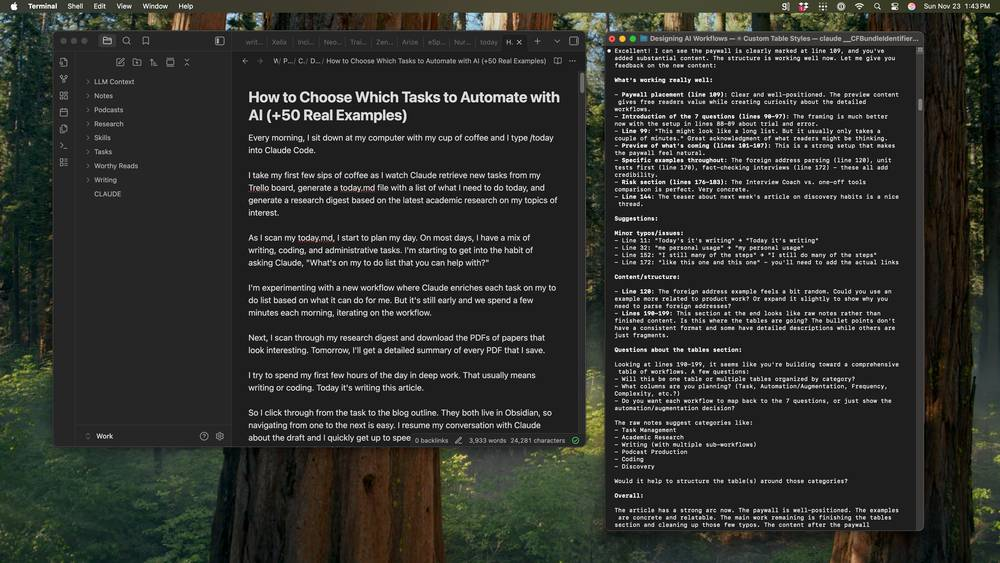
Working with Claude makes it easier to stay in motion. One small but surprisingly effective shift is that Claude keeps asking whether you are ready to write the next section. It is a tiny prompt, but sometimes that is all it takes to keep momentum alive and stay focused longer.
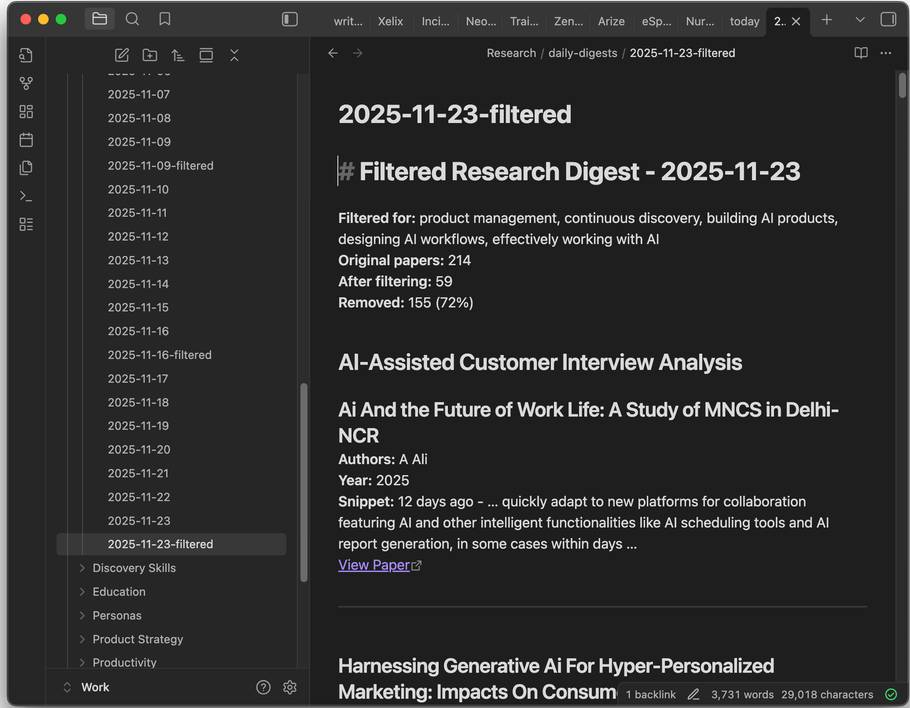
A separate academic research workflow makes it easier to keep up with the topics that matter most. Instead of wasting energy hunting for papers, the process brings relevant research to you. And because more time is spent refining the structure of an article before drafting it, less time gets wasted cutting unnecessary sections later.
Writing is a perfect example of AI helping someone become even better at something they already do well.
Use AI to get rid of the work you hate
There are also tasks you may be thrilled to automate almost completely.
For example, maybe you genuinely enjoy reading academic papers about creativity, collaboration, AI effectiveness, or related topics—but you hate searching for them. That search process is tedious, repetitive, and easy to offload.
So it makes sense to automate it.
A research workflow can run every morning, search for relevant new papers, and add them to a daily briefing for later review. Instead of spending your energy digging through sources, you spend it on the part you actually care about: reading, thinking, and applying what you find.
That is the sweet spot.
AI does not just save time. It clears away the parts of the process that make you less likely to do the work at all.
Choosing your first AI workflow
As you go through your daily work, start asking yourself one simple question:
Could AI help with this?
That question sounds basic, but it is powerful if you ask it often enough.
There are plenty of books, blog posts, and frameworks about delegation and productivity, but most of the advice boils down to something much simpler:
- become more aware of how you spend your time
- identify the tasks that can be delegated
- protect your time for the work you are best at
That is also a strong starting point for deciding how AI fits into your workflow.
People often focus only on automations that save time or make them more efficient. That matters, of course. But it is not the whole picture.
Do not ignore the work you love doing and want to do more of.
In many cases, that is where AI delivers the biggest return—not by replacing you, but by supporting the part of your work that matters most.
Yes, you should automate what can be automated.
But the more interesting opportunity is often using AI to strengthen the things you already do better than anyone else.
So as you work today, keep asking:
How could AI help with this?
Ask it over and over again. Let that question drive your experiments.
How to tell whether a task is a good candidate for AI
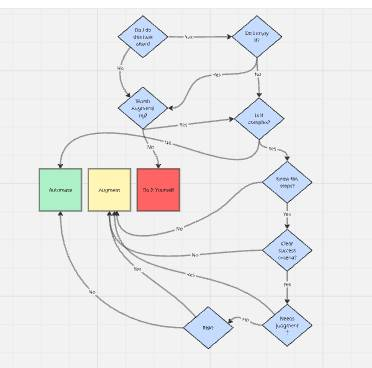
Over time, usually through a mix of trial and error, you start developing a better instinct for which tasks are worth turning into AI workflows.
When a new task comes up, it helps to ask a few quick questions:
- Is this a one-off task, or does it happen regularly?
- Do I enjoy doing this, or would I happily hand it off?
- How complex is it?
- Can I clearly explain the process step by step?
- Does this task require human judgment?
- Can I define what success looks like?
- What is the risk if it is done badly?
That may look like a long list, but in practice it only takes a few minutes.
And the answers are useful.
They help you figure out whether a task is worth investing in as an AI workflow, whether it should be fully automated or only partially assisted, and which parts still need to stay in your hands.
Where to start
The hardest part is often not building the workflow.
It is deciding where to begin.
That is why inspiration matters. Once you see enough examples, it becomes much easier to spot opportunities in your own day-to-day work.
You do not need to redesign your entire life around AI in one shot.
You just need one good starting point.
One repetitive task.
One annoying bottleneck.
One area where a little support would make your best work easier to do.
That is enough to begin building your first real AI workflow today.






'%3e%3cg id='Final-Copy-2_2_' transform='translate(1275.000000, 200.000000)'%3e%3cpath class='st0' d='M7.4,12.8h6.8l3.1-11.6H7.4C4.2,1.2,1.6,3.8,1.6,7S4.2,12.8,7.4,12.8z'/%3e%3c/g%3e%3c/g%3e%3c/g%3e%3cg id='final---dec.11-2020'%3e%3cg id='_x30_208-our-toggle' transform='translate(-1275.000000, -200.000000)'%3e%3cg id='Final-Copy-2' transform='translate(1275.000000, 200.000000)'%3e%3cpath class='st1' d='M22.6,0H7.4c-3.9,0-7,3.1-7,7s3.1,7,7,7h15.2c3.9,0,7-3.1,7-7S26.4,0,22.6,0z M1.6,7c0-3.2,2.6-5.8,5.8-5.8 h9.9l-3.1,11.6H7.4C4.2,12.8,1.6,10.2,1.6,7z'/%3e%3cpath id='x' class='st2' d='M24.6,4c0.2,0.2,0.2,0.6,0,0.8l0,0L22.5,7l2.2,2.2c0.2,0.2,0.2,0.6,0,0.8c-0.2,0.2-0.6,0.2-0.8,0 l0,0l-2.2-2.2L19.5,10c-0.2,0.2-0.6,0.2-0.8,0c-0.2-0.2-0.2-0.6,0-0.8l0,0L20.8,7l-2.2-2.2c-0.2-0.2-0.2-0.6,0-0.8 c0.2-0.2,0.6-0.2,0.8,0l0,0l2.2,2.2L23.8,4C24,3.8,24.4,3.8,24.6,4z'/%3e%3cpath id='y' class='st3' d='M12.7,4.1c0.2,0.2,0.3,0.6,0.1,0.8l0,0L8.6,9.8C8.5,9.9,8.4,10,8.3,10c-0.2,0.1-0.5,0.1-0.7-0.1l0,0 L5.4,7.7c-0.2-0.2-0.2-0.6,0-0.8c0.2-0.2,0.6-0.2,0.8,0l0,0L8,8.6l3.8-4.5C12,3.9,12.4,3.9,12.7,4.1z'/%3e%3c/g%3e%3c/g%3e%3c/g%3e%3c/g%3e%3c/svg%3e)


0 comments