


A bullet is tiny, but the force it can deliver is anything but small.
To understand why, it helps to look at how a bullet is built, what happens the moment a gun is fired, and which forces act on the bullet as it leaves the barrel and travels toward a target.
The impact of a bullet depends on several key factors: its diameter, its weight, and its speed. Understanding how those variables work together helps explain why different bullets are designed for different purposes, whether the goal is range, penetration, stopping power, or precision.

There are also different ways to describe what a bullet does when it hits something. In some cases, people focus on how much energy it transfers to the target. In others, they look at momentum, penetration, or overall destructive potential. Online ballistic calculators can estimate these values, but all of them rely on the same basic physics: mass, velocity, momentum, kinetic energy, acceleration, and force.
Speed matters enormously. So does shape.
A bullet can reach astonishing velocity, far faster than anything we encounter in everyday life. That is what makes its impact so dangerous. But how can such a small object move so quickly in the first place? And what exactly happens between the pull of a trigger and the moment the bullet hits its target?
Let’s break it down.
What a bullet is made of
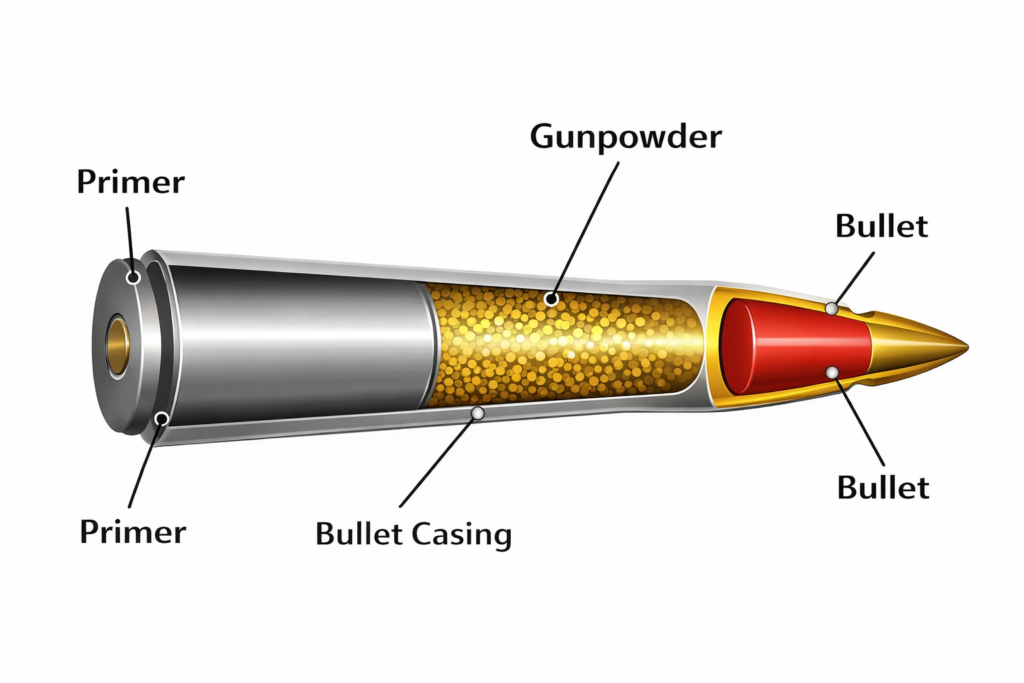
A cartridge is usually made up of three main parts: the projectile, the propellant, and the primer.
The primer, located at the rear, acts like an ignition point.
The propellant is the chemical charge that generates the gas pressure needed to launch the bullet forward.
The bullet itself is the metal projectile at the front, typically shaped to reduce air resistance and improve penetration.
Each of these components has a specific role, and together they create a compact but highly efficient system.
What happens when the trigger is pulled?
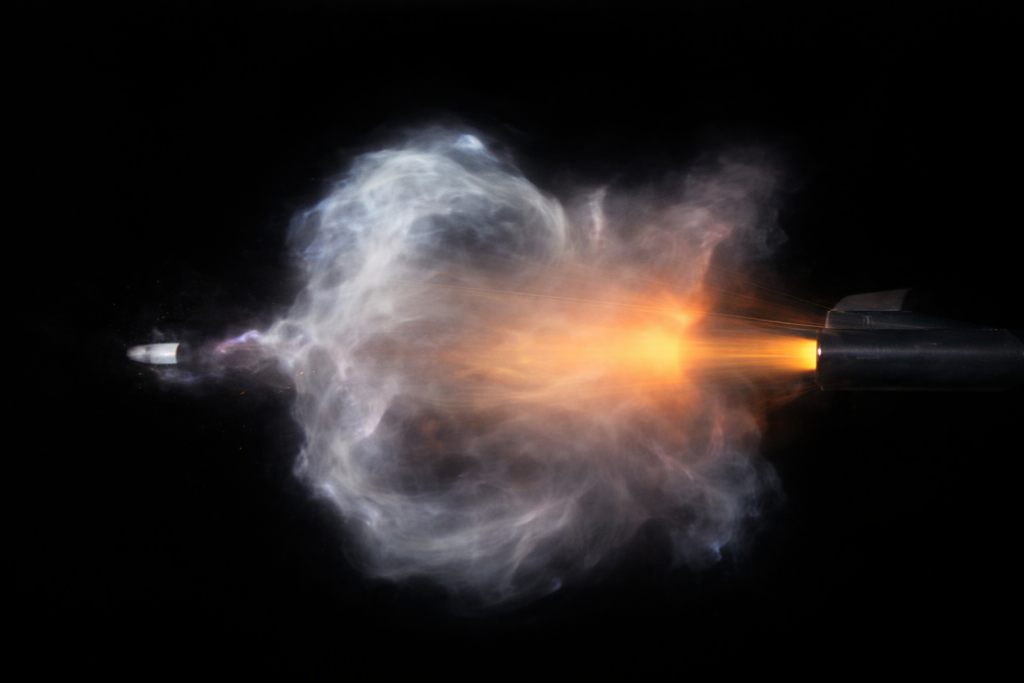
When the trigger is pulled, the firearm’s firing mechanism strikes the primer at the back of the cartridge. That impact ignites the primer, which in turn ignites the propellant.
As the propellant burns, it produces a large volume of hot, rapidly expanding gas. That gas creates intense pressure inside the chamber, forcing the bullet down the barrel at extremely high speed.
In handguns and rifles alike, this process happens in a fraction of a second. The design is carefully controlled so the pressure builds in a usable way rather than exploding all at once. If it did not, the firearm itself could fail catastrophically.
The moment the bullet is driven forward, the gun also pushes backward. That is recoil, a direct result of Newton’s laws of motion. At the same time, the sudden release of pressure creates the loud report we hear as a gunshot.
How a bullet moves through the air
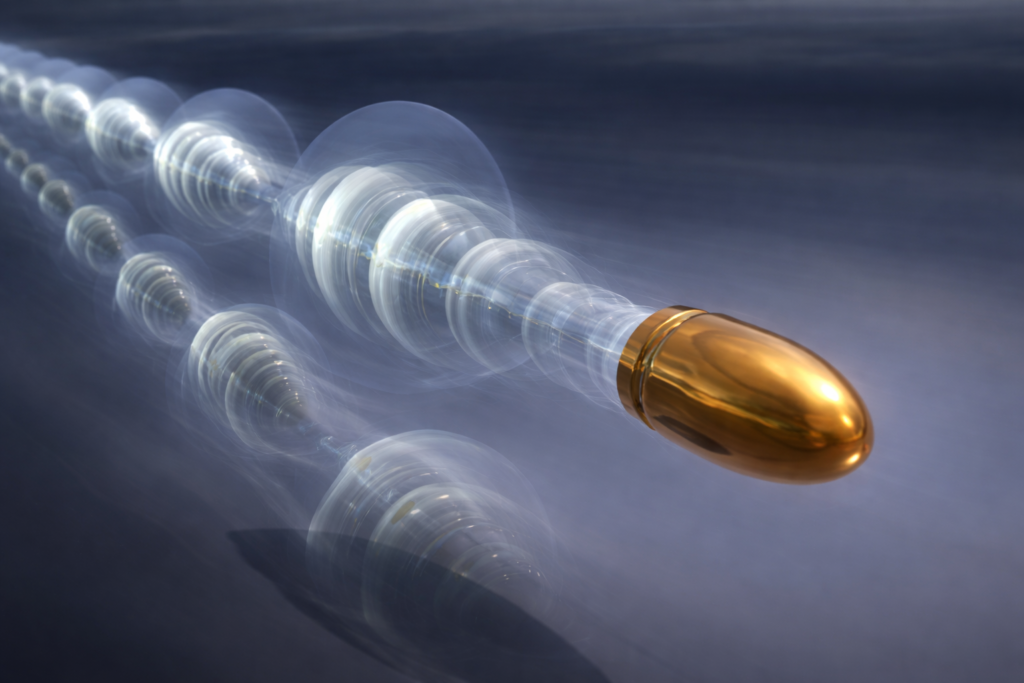
Once it leaves the barrel, the bullet does not simply fly like a dart in a perfectly straight line.
Most gun barrels are rifled, meaning they contain spiral grooves that cause the bullet to spin rapidly as it travels forward. That spin stabilizes the bullet, helping it stay pointed in the right direction and improving accuracy.

Even then, the bullet is still affected by several forces during flight. Air resistance slows it down. Gravity pulls it downward. Spin stabilization and gyroscopic effects influence how it behaves as it moves.
At short distances, a bullet may appear to travel almost in a straight line. Over longer distances, however, its path curves downward because gravity is always acting on it.
So while the flight may look simple from the outside, the actual motion is far more complex.
Why a bullet’s impact is so destructive

What makes a bullet so dangerous is not just that it is made of metal. It is the combination of mass and extreme speed.
A bullet carries significant momentum, but even more importantly, it carries a large amount of kinetic energy. And kinetic energy rises with the square of velocity. That means if the speed doubles, the kinetic energy increases fourfold.
This is why velocity matters so much in ballistics.
When a bullet strikes a target, it loses speed very quickly and transfers energy over a very short period of time and a very small area. That is what produces such devastating effects. The damage comes not only from the object itself, but from how suddenly its energy is delivered.
In simple terms: the faster the bullet, and the faster it is forced to stop, the greater the force involved in the impact.
That is why something so small can cause such catastrophic damage.
The physics behind the fear
It is easy to underestimate a bullet because of its size. But physics does not care about appearances.
A compact object moving at very high velocity can carry enormous destructive potential. The bullet’s shape helps it cut through the air efficiently. Its spin helps it stay stable. Its propellant gives it speed. And once that speed is converted into impact, the result can be severe in an instant.
That is the unsettling truth behind ballistics: a bullet does not need to be large to be terrifyingly powerful.







'%3e%3cg id='Final-Copy-2_2_' transform='translate(1275.000000, 200.000000)'%3e%3cpath class='st0' d='M7.4,12.8h6.8l3.1-11.6H7.4C4.2,1.2,1.6,3.8,1.6,7S4.2,12.8,7.4,12.8z'/%3e%3c/g%3e%3c/g%3e%3c/g%3e%3cg id='final---dec.11-2020'%3e%3cg id='_x30_208-our-toggle' transform='translate(-1275.000000, -200.000000)'%3e%3cg id='Final-Copy-2' transform='translate(1275.000000, 200.000000)'%3e%3cpath class='st1' d='M22.6,0H7.4c-3.9,0-7,3.1-7,7s3.1,7,7,7h15.2c3.9,0,7-3.1,7-7S26.4,0,22.6,0z M1.6,7c0-3.2,2.6-5.8,5.8-5.8 h9.9l-3.1,11.6H7.4C4.2,12.8,1.6,10.2,1.6,7z'/%3e%3cpath id='x' class='st2' d='M24.6,4c0.2,0.2,0.2,0.6,0,0.8l0,0L22.5,7l2.2,2.2c0.2,0.2,0.2,0.6,0,0.8c-0.2,0.2-0.6,0.2-0.8,0 l0,0l-2.2-2.2L19.5,10c-0.2,0.2-0.6,0.2-0.8,0c-0.2-0.2-0.2-0.6,0-0.8l0,0L20.8,7l-2.2-2.2c-0.2-0.2-0.2-0.6,0-0.8 c0.2-0.2,0.6-0.2,0.8,0l0,0l2.2,2.2L23.8,4C24,3.8,24.4,3.8,24.6,4z'/%3e%3cpath id='y' class='st3' d='M12.7,4.1c0.2,0.2,0.3,0.6,0.1,0.8l0,0L8.6,9.8C8.5,9.9,8.4,10,8.3,10c-0.2,0.1-0.5,0.1-0.7-0.1l0,0 L5.4,7.7c-0.2-0.2-0.2-0.6,0-0.8c0.2-0.2,0.6-0.2,0.8,0l0,0L8,8.6l3.8-4.5C12,3.9,12.4,3.9,12.7,4.1z'/%3e%3c/g%3e%3c/g%3e%3c/g%3e%3c/g%3e%3c/svg%3e)


0 comments